
Red cabbage & fennel seed kraut and Cauliflower ‘piccalilli’ pickle
It’s January! You’ve perhaps overindulged in December and you want to rebalance your life and your gut and your diet without it feeling restrictive and depressing! I cannot recommend making your own fermented vegetables enough - it is really easy to do, a great way to use up/preserve any vegetables that are languishing in the bottom drawer of the fridge and they are so delicious!
There is so much evidence now of the benefits of including more fermented food in our diets - feeding our good gut bacteria, helping us digest rich foods, speeding up our recovery after illness and replenishing our guts after taking antibiotics! What is not to love?
I’ve posted recipes here for a sauerkraut, which uses salt and the liquid released from the shredded veggies to create the ferment and then a ‘pickle’ which is fermented in brine (a mixture of water and salt). Once you’ve mastered the techniques - which isn’t difficult - you can experiment with whatever flavours and veggies you desire. If you fancy making a kimchi you can find my recipe here.
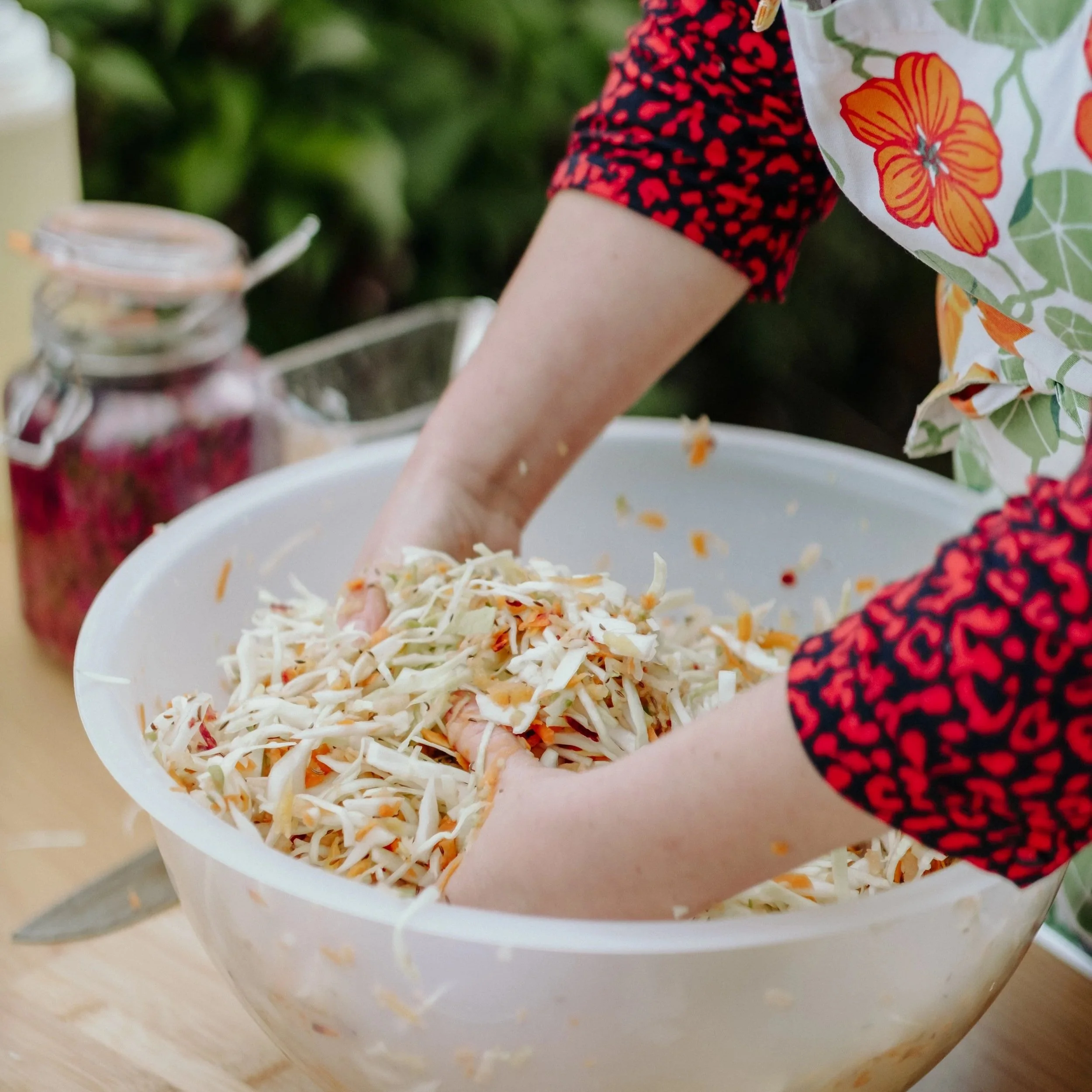
For the red cabbage & fennel seed kraut:
Makes about 1 litre of sauerkraut
700g red cabbage (weighed once core removed and finely sliced), plus a few whole leaves to put on top of the kraut and keep everything under water)
300g carrots (weighed once peeled and grated)
100g apples (weighed once cored and grated)
2 teaspoons fennel seeds
1 teaspoon chilli flakes
1 cinnamon stick
20g sea salt (2% of the total weight of vegetables)
1. Remove any brown or damaged outer leaves from the cabbage, slice it into long thin strips avoiding the core and put it in a large bowl. Peel and grate the carrots and add them to the bowl with the cabbage. Grate the apples roughly (avoiding the core) and add them to the other vegetables.
2. Lightly toast the fennel seeds in a dry frying pan, just for a minute or two until you can smell the flavour. Add the fennel seeds, chilli flakes & cinnamon stick to the cabbage, carrot and apple mix and use your hands to mix well and soften everything.
3. Now add the salt and massage again thoroughly for a minute. Lots of water will be released. Pack the mixture tightly into a clean glass jar (or jars) leaving a bit of headroom at the top as the liquid will increase as it ferments. Then put a couple of cabbage leaves on top of the mixture to hold everything under the liquid. You can also add a weight if you need to, but I find the cabbage leaves are usually good enough.
4. I also put my jar onto a plastic tray or in a shallow Tupperware box (without the lid) as I find this combination emits a lot of water and it sometimes leaks out the top of the jar. If there is too much liquid, I just ladle a bit out and discard it.
5. Leave the sauerkraut in a warm-ish part of the house. You will probably start to see fermentation happening after 2-3 days, but if depends on how warm the room is. Taste every couple of days, once it is ready it will taste a bit sour, and all the flavours will have melded. It is then ready to eat. Opening the jar will also release any build-up of gas so you are ‘burping’ the sauerkraut. You will sometimes hear a small ‘pop’ as you open the jar.
6. Once you like the flavour you can then store it in the fridge. This will slow down the fermentation but, nevertheless, the longer you keep it, the sourer it will get. These flavours are just a suggestion wxperiment with your own combinations!
For the Cauliflower ‘Piccalilli’ pickle
Makes about 1.5 litres of pickle
1 small cauliflower head, cut or broken into small, bitesize chunks
1 large carrot, cut into rounds
4 spring onions, cut into chunky slices
5g fresh turmeric, peeled and sliced
10g fresh ginger, peeled and sliced
2 large cloves garlic, peeled and sliced
2 teaspoons cumin seeds
2 teaspoons mustard seeds
2% brine solutions (i.e 20g sea salt dissolved in 1 litre of filtered or boiled and cooled water)
A couple of cabbage leaves to hold the vegetables under the brine
1. Prepare the cauliflower, carrots, spring onions, turmeric, ginger and garlic and pack into clean glass jar or jars, trying to distribute the flavourings evenly throughout the jar.
2. Lightly toast the cumin and mustard seeds in a dry frying pan, just for a minute or two until you can smell the flavour. Add the seeds to the jar or jars of prepared vegetables.
3. Pour over the brine, leaving a bit of headroom at the top of the jar – about 2-3cm. Veggies expand as they ferment so this stops it leaking/being too explosive as there is somewhere for the gases to escape to. I also put the jars on a tray or in a plastic box as if they leak a bit, it is easy to clean up.
4. Weigh down the veggies with a cabbage leaf or weight so they stay submerged in the liquid.
5. Leave at room temperature for a few days. After about two to three days, you will start to see activity in the jar – bubbles and the jar may pop as you open it to let gas escape. Taste as you go and when you like the flavour pop it in the fridge. This will slow fermentation down. I like these eaten within the first couple of weeks generally as they are crisper, but they will be fine to eat if kept in the fridge for at least a couple of months.